Quick Summary
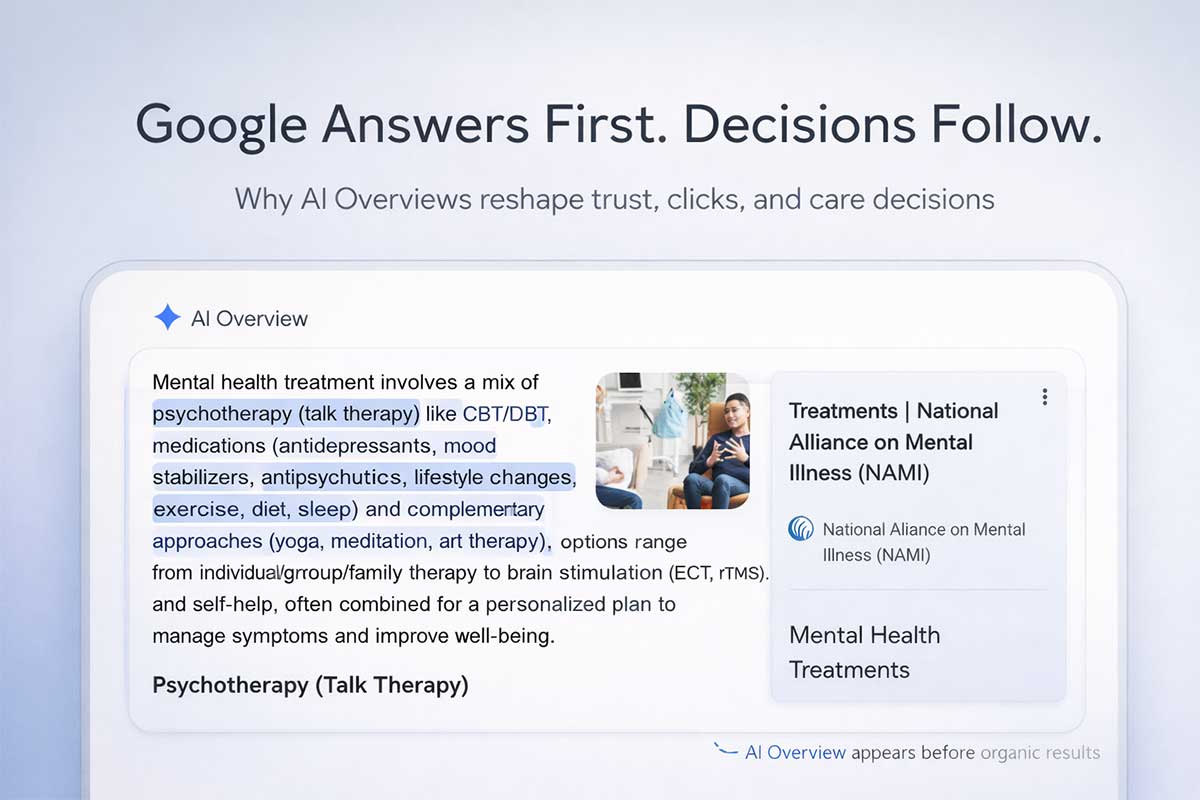
AI Overviews are changing how people move through Search, not whether they search. For treatment and mental health programs, the win is earning trust earlier, showing up across more “fit” queries, and making next steps obvious when someone is ready.
Key Takeaways
- What changed: Google is using AI to answer faster, then users keep searching to compare, verify, and choose.
- What to publish: Fewer, stronger “decision pages” that cover level of care, who it’s for, what happens next, insurance access, and what to expect.
- How to earn visibility: Write in quotable blocks (definitions, checklists, steps) and pair key topics with video, reviews, and clear authorship signals.
- How to measure success: Track qualified calls and fit, not raw traffic. Reduce confusion with clear program fit, pricing or insurance clarity, and next steps near the top.
Google Search is not simply “adding AI.” It is changing how people discover information, decide what to trust, and choose where to go next.
In a Wall Street Journal Bold Names interview, Liz Reid, Google’s VP and Head of Search, described this moment as “the most profound shift” for Search, because it is an information product and the technology is “fundamentally changing” how information can be delivered.
She was not speaking about addiction treatment or mental health specifically. But the behaviors she describes are exactly what families and patients do when they are searching for care: they want quick clarity, proof they can trust, and the next step to feel safe.
Below are the most actionable takeaways from her comments, translated for treatment centers and behavioral health brands.
AI Overviews Are Changing the Path, Not Ending the Search Market
A lot of commentary assumes AI Overviews will collapse clicks and destroy Google’s paid search incentives. Reid’s explanation points in a different direction.
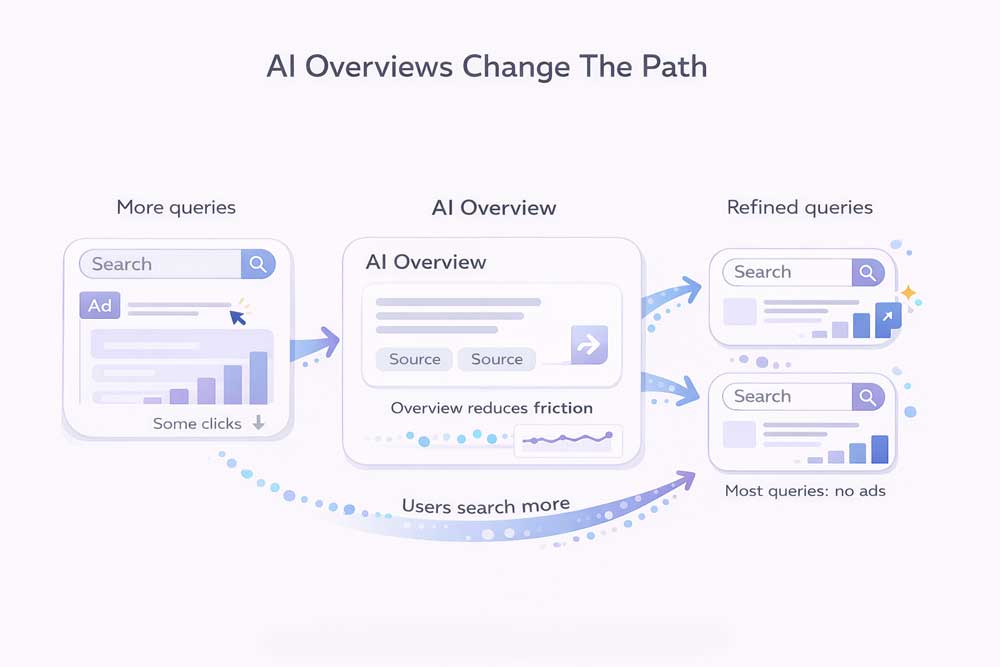
She says “the revenue with AI Overviews has been relatively stable,” and explains why: some searches may lead to fewer ad clicks, but AI Overviews also “grows overall queries so people do more searches.” She also points out something that gets overlooked: “most queries don’t have any ads at all.”
Google has publicly shared how AI features interact with websites in Search, including how AI Overviews surface information and sources.
For behavioral health marketing, the key point is not whether a single search produces a click. The key point is that people will search more times, in more steps, until they feel confident.
That matters because the treatment decision almost never occurs on a single query. A typical pattern looks like:
- Broad orientation: “mental health treatment options”
- Comparison: “PHP vs IOP”
- Fit: “women’s trauma residential”
- Access: “PPO coverage for residential treatment”
- Trust: reviews, video, forum confirmation
- Action: call and verify insurance
When AI reduces friction, the funnel becomes more iterative. Brands that show up across the comparison and fit stages tend to win, even if the first search never turns into a click.
What we see in the real world is simple: when people get a quick overview, they do not stop researching. They sharpen the question. That is exactly what we see with treatment searches. The programs that win show up consistently across the refined queries, not just the first generic one.
What to do now
- Build content and campaigns around decision-stage searches: level of care, clinical fit, and access questions.
- Make “next steps” obvious so the right people can act quickly when they are ready.
- Measure leads by quality, not volume, because faster funnels can also produce more mismatched inquiries.
Traffic Volatility Is Not Only AI. Reid Ties It to a Behavioral Shift in Where People Go for Answers
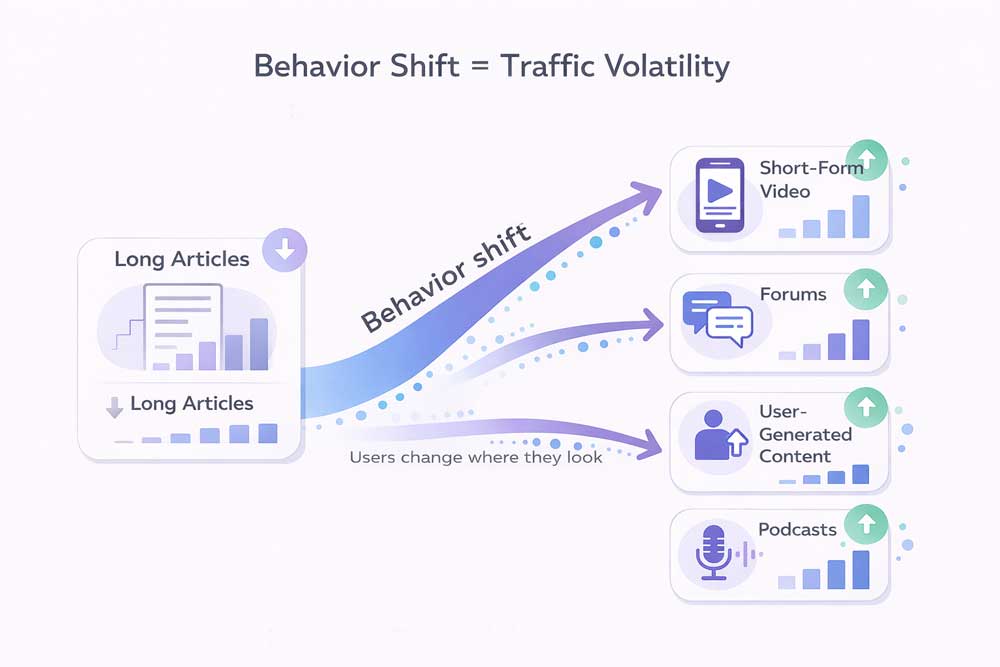
When asked about publishers seeing major traffic drops, Reid says there are always “winners and losers” with ranking updates, but she also points to something larger happening at the same time: a “behavioral shift.”
She describes users, especially younger users, “going to short-form video,” “going to forums,” “user-generated content,” and “podcasts,” “rather than reading the long article.”
If you work in treatment marketing, you have already seen this in practice.
Families often trust:
- a short clip explaining a level of care
- a YouTube walkthrough of “what residential is like”
- a forum thread that feels real, even if imperfect
- reviews that signal safety, compassion, and legitimacy
This does not mean websites are irrelevant. It means websites are no longer the only place decisions are shaped. This shift mirrors broader reporting on how Google is adapting Search to changing user behavior and discovery patterns.
What to do now
- Treat visibility as multi-format: written pages, video, plus reputation.
- Publish content in the format people use for that question. Some topics need a guide, some need a short video, some need both.
- Make sure the website is the place where research turns into action, not the only place research happens.
Google Is Adjusting Rankings Based on Observed User Behavior, Not Guessing
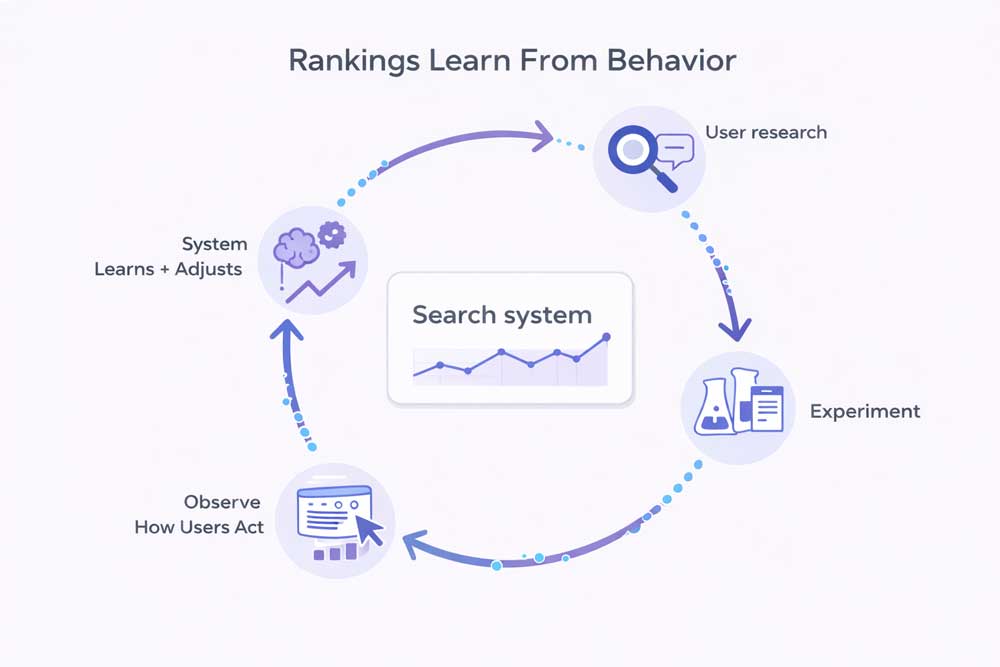
Reid explains the feedback loop: Google does “user research,” runs “an experiment,” watches “how users actually act,” and then “the system starts to learn and adjust as well.”
She also says something that should be taken literally: “We do have to respond to who users want to hear from.”
In other words, if people consistently prefer certain formats or sources for certain questions, Search will trend that direction.
For treatment centers, this changes the strategic question from:
“How do we rank our blog post?”
to:
“How do we show up where people actually look, and then earn trust when they land?”
What to do now
- Stop relying on one content type. Build a small set of high-quality assets across formats.
- Align topics with real admissions conversations, not generic keyword lists.
- Build strong brand signals so people recognize the name across the journey.
Trust Is a Core Expectation, and People Are Using Search to Verify What AI Tools Say
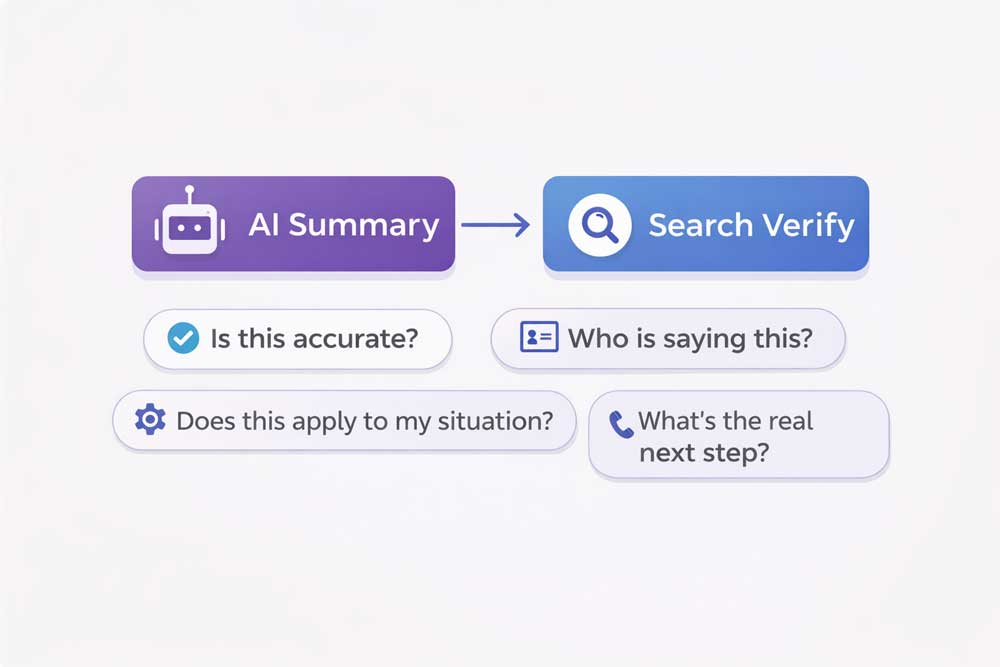
Reid notes that people “hold Google to a high level of responsibility,” and says users sometimes go to chatbots, then “come to us to check the answer.”
That has a direct implication for healthcare and behavioral health: Search is becoming the verification layer and Google has consistently emphasized higher responsibility and accuracy expectations for health and medical topics.
People may get a summary from an AI tool, but then they want confirmation:
- “Is this accurate?”
- “Who is saying this?”
- “Does this apply to my situation?”
- “What’s the real next step?”
Reid also talks about how people use tools to “get started.” That is exactly the treatment context. Families often do not need a perfect answer first. They need a clear direction that reduces overwhelm.
What to do now
- Write and structure content so it helps someone get started, then go deeper.
- Build trust on-page with specifics: processes, oversight, what to expect, and what happens next.
- Avoid vague marketing language. In this category, vague language reads as risk.

Google is Actively Filtering “Low-Value Content,” Not Just Obvious Spam
This is one of the most important lines in the transcript for any marketing team.
Reid says Google has expanded beyond traditional spam into “low-value content,” which she describes as content that “doesn’t add very much,” and “tells you what everybody else knows.” Google’s own documentation describes this shift toward prioritizing helpful, people-first content that demonstrates real expertise.
She says the goal is to “upweigh” content where someone “brought their perspective,” “brought their expertise,” and “put real time and craft into the work.”
In treatment marketing terms, this is the warning sign for template pages.
Generic content like “what is anxiety” will keep getting harder to defend as a strategy. The content that survives is the content that only a real provider can write because it reflects real operations and real expertise:
- How intake works and what happens on day one
- How levels of care are determined
- What family involvement looks like
- How Co-Occurring Disorders Change Treatment Planning
- What aftercare and step-down planning looks like in practice
What we’ve seen repeatedly is that generic, templated content sometimes gets visibility, but it rarely holds. We’ve tested various levels of AI-produced content for several years, and the pattern is consistent: the more a page reads like a summary of what is already online, the less durable it is. And as Google expands beyond traditional spam into “low-value content,” the kind that “doesn’t add very much” and “tells you what everybody else knows,” it is hard to believe that spammy AI pages will keep ranking in any long-lasting way.
Even when a low-value page briefly appears, it often fails where it matters: it does not earn trust or convert. The pages that hold up are the ones that go beyond surface-level summaries and answer the uncomfortable questions clearly, like what happens if symptoms escalate, how family involvement really works, how level-of-care decisions are made, and what day-to-day care actually looks like. That is the kind of detail people cannot get from a generic overview, and it is the kind of content Google has a reason to keep surfacing.
What to do now
- Replace content quantity goals with content usefulness goals.
- Build fewer pages, but make them unmistakably better.
- Bring the clinician and leadership perspective into the content so it cannot be mistaken for generic AI output.
“Bounce Clicks” and Satisfaction Matter More When AI Is Giving the Overview
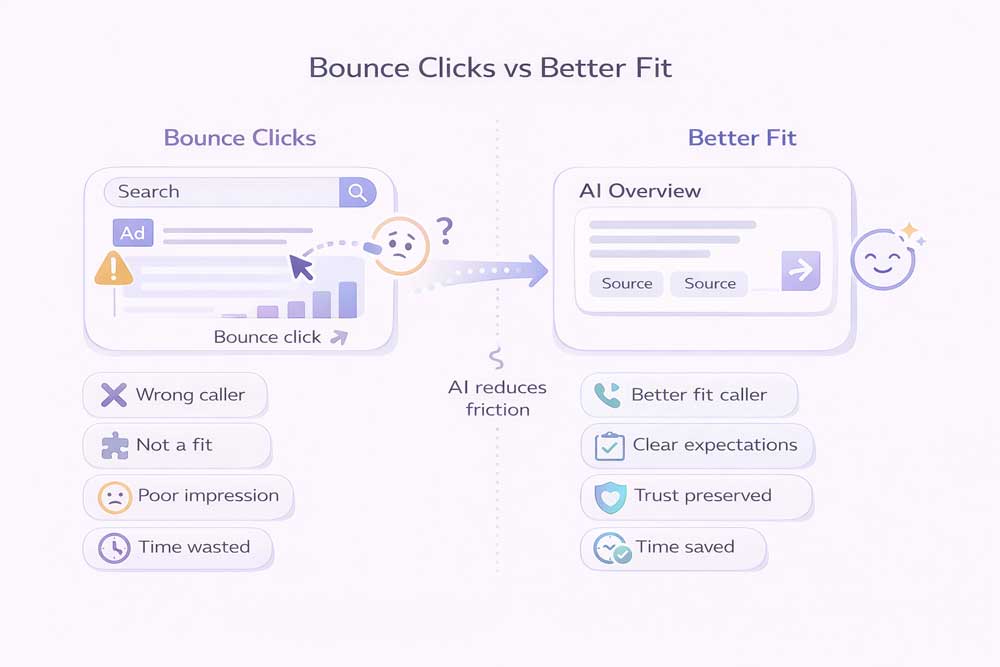
Reid describes “bounce clicks” as clicking a result, then immediately thinking, “I didn’t want that,” and returning to the results page. She says AI Overviews can reduce these and help surface “deeper, richer content.”
In behavioral health, “bounce clicks” are not just an SEO issue. They become admissions friction:
- The wrong caller reaches out
- The call is not a fit
- The person leaves with a worse impression
- The brand burns time and trust
In this space, bounce clicks are not just a metric. They show up as confused callers, misfit inquiries, and longer admissions cycles. When pages set expectations early, call quality improves, and teams spend more time on the people they can truly help.
What to do now
- Make fit clear. Who is this program for, and who is it not for?
- Put the key answers at the beginning: levels of care, specialties, insurance, and next steps.
- Design pages to reduce anxiety and confusion, not to impress a search crawler.
Inline Links in AI Overviews Are a New Distribution Channel, Not Just a Citation Detail
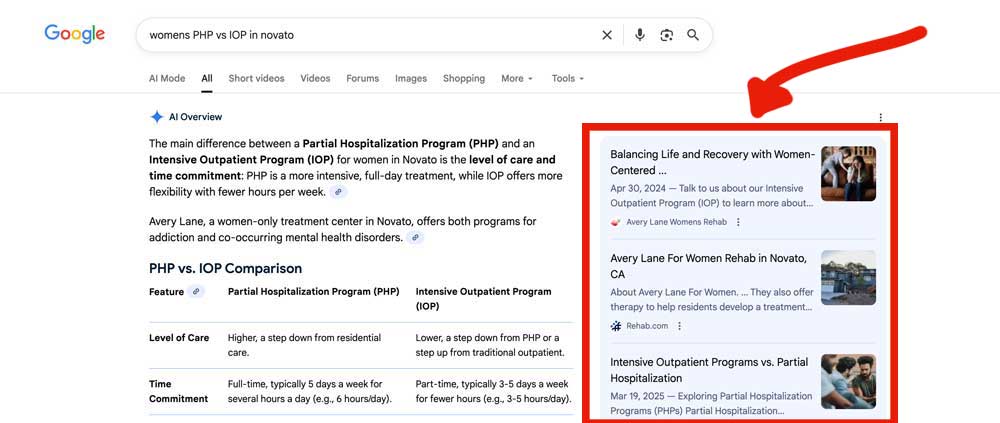
One of the more important points Reid made is that Google is actively working on how to surface creators and publishers inside AI Overviews, because the “health of the web” is essential to Search. Her practical example is inline links inside AI Overviews. Google has stated that supporting creators and the health of the web remains essential as AI features evolve.
In plain terms, instead of AI Overviews summarizing a topic and burying sources, Google can label sources directly in the answer with a prominent link, like “according to [source].” Reid describes this as a way to drive both brand visibility and click-through at the same time.
Why this matters for addiction treatment and mental health marketing
For treatment and mental health searches, a user often needs reassurance fast, then proof they can trust. When a provider is referenced inline as the “according to” source, it does two things:
- Builds credibility at the exact moment someone is forming an opinion, even if they do not click right away.
- Improves the quality of the click when it happens, because the user is clicking with context and intent rather than guessing.
This is especially relevant for high-stakes, decision-heavy queries like:
- Inpatient mental health care vs outpatient
- Signs someone needs residential care
- What dual diagnosis treatment for women includes
- How can men rebuild after detox in outpatient care
- PHP vs IOP vs Outpatient Treatment
- How family involvement works in treatment
What to do now
If the goal is to become the kind of source Google can reference inline, content has to be built differently than traditional “SEO blog posts.”
- Write in quotable blocks. Use short definitions, clear steps, and checklists that answer one question cleanly.
- Create definitive pages, not endless posts. Build a small set of pages that are the best answers for specific topics that families and patients repeatedly search for.
- Show real expertise. Include clear authorship and clinical review where appropriate, and add operational detail that generic pages never include.
- Support multiple formats. Reid also mentions surfacing videos in these experiences. Pair key pages with video when it makes sense, so the brand can show up in more than one way.
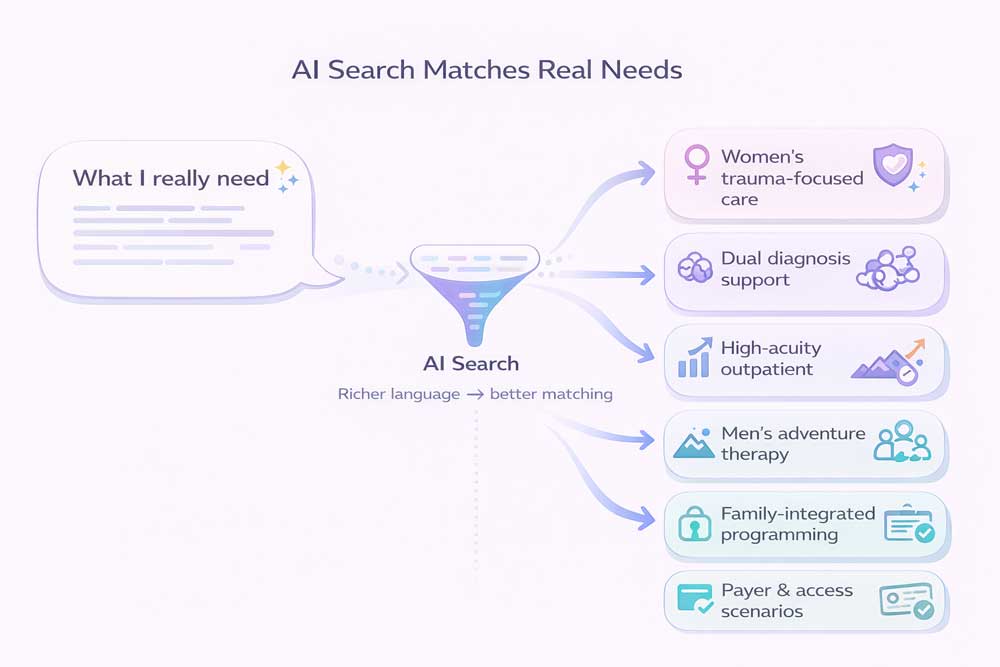
AI Search Can Help Specialized Programs Get Discovered
Reid explains that AI lets users express what they really want in richer language, which can help connect people to niche creators or merchants that would not be found with “vanilla keywords.”
The behavioral health equivalent is specialization.
The more clearly a program serves a specific population or need, the more AI-driven search can match it:
- Women’s trauma-focused residential care
- Dual diagnosis with mood disorder support
- High-acuity outpatient tracks
- Men’s adventure therapy
- Family-integrated programming
- Payer and access scenarios
What to do now
- Build pages around real fit scenarios, not broad labels.
- Use language people actually use when describing their needs.
- Make the specialization obvious quickly, without forcing someone to hunt for it.
The Takeaway for Treatment Center Marketing Teams
Reid’s interview does not suggest that Search is going away. It suggests that Search is becoming more helpful, more multi-step, and more selective about what it surfaces.
Marketing teams in addiction treatment and mental health can respond with a simple strategy shift:
- Stop chasing generic traffic.
- Build trust-first assets that help real people make real decisions.
- Show up across formats, not only one.
- Make the program fit and the next steps obvious.
If Search is becoming a place where people get started, verify, and then decide, treatment brands need to meet them in all three moments.
Want Help Adapting to AI-Driven Search?
We work with addiction treatment and mental health providers who want their site to do more than rank, they want it to earn trust, reflect clinical expertise, and convert with clarity.
That starts with human-first content. We write and build website pages and blog content the way real people research care: with context, clarity, and specifics that go beyond surface-level summaries. Every piece is supported by rock-solid SEO fundamentals, but the goal is bigger than rankings. It is brand recognition, credibility, and consistency across the full decision journey.
Our work typically includes:
- Search strategy built around intent, including level of care, clinical fit, and access questions.
- Content that is genuinely useful, with deeper explanations, clear next steps, and trust-building detail that generic pages do not include.
- On-page trust signals, including authorship, clinical review where appropriate, and messaging that makes safety and oversight easy to understand.
- SEO foundations that compound, like site structure, internal linking, and topic authority that support both traditional results and AI-driven surfaces.
- Measurement that focuses on outcomes, so marketing stays aligned with real admissions performance.
Get a free site audit to pressure-test your pages
✅ Are your pages built for today’s AI-powered decision path?
✅ Would a family member trust what they see in the first 10 seconds?
✅ Do your pages make program fit and next steps obvious?
Let’s find out. 👉 Request Your Free Audit – No pressure, just real feedback from a team that understands behavioral healthcare.