Quick Summary
Video helps addiction treatment and behavioral health providers earn trust faster in local search. Short, privacy-safe clips that show the environment, explain what happens next, and connect the program to the local community reduce uncertainty for people who are nervous about reaching out and support stronger Google Business Profile performance.
4 Key Takeaways
- Clarity beats polish. A steady set of simple videos answers the questions people have before they call, what the space feels like, what the process looks like, and what happens next.
- Shorts are the easiest starting point. Consistent vertical videos can show up where local searches happen and create a “vibe check” that photos cannot.
- Keep filming privacy-safe and compliance-first. Film empty spaces, avoid capturing clients or voices, and skip anything that implies outcomes or guarantees.
- Use repeatable formats, not random posts. Rotate a few proven video types, tours, next steps, levels of care explanations, clinician education, and community credibility, so content stays consistent without becoming a huge workload.
Most addiction treatment and behavioral health organizations put real effort into their website, a handful of photos, and a solid description on their Google Business Profile. That is a good baseline, but it is rarely what tips a hesitant person from “maybe” to “I’m calling.”
Video does that job better than static media because it answers the unspoken questions fast: Is this place real? Is it safe? Do they feel professional? Do they feel human?
This topic has been highlighted by Google in its Small Business Bulletin, which has been encouraging small businesses to use video and Shorts as part of modern visibility. You can see the original bulletin discussion in Google’s thread on the Google Small Business Bulletin checklist.
What “Video Strategy” Means For A Treatment Center
A practical video strategy connects three things:
Trust content: quick visuals that prove the place is legitimate, calm, and well-run.
Answer content: simple explanations of how care works and what happens next.
Local signals: content tied to your city and service area so it shows up where it matters.
This can be done with a phone, a basic plan, and a repeatable process. No production crew required.
Start Where Local Decisions Happen: Your Google Business Profile
Your Google Business Profile is often the first impression, even before the website. Adding video there helps people understand the environment and professionalism without clicking around.
Two practical moves:
Add short videos directly to your profile.
Facility walkthroughs, “what to expect” clips, and admissions explanations do well because they reduce uncertainty.
Connect your YouTube channel to your profile.
Google allows businesses to add a YouTube link as a social media link in GBP, and Google explains how to do this in its documentation on adding social media links to a Business Profile. That connection creates a clean bridge between your best video content and your local listing.
Video works best when it builds on a solid GBP foundation. If you want the bigger picture on what actually moves the needle in local rankings for treatment providers, this GBP ranking guide for addiction treatment and mental health in 2026 lays it out in plain terms.
Why Shorts Matter For Local Visibility Right Now
Short-form video is not just entertainment anymore. People use video to learn, compare, and make decisions. Google has leaned into this behavior with research and strategy guidance, including its overview of why video-first content strategies are winning attention.
For treatment providers, the value is straightforward:
- Shorts let you communicate safety and professionalism quickly.
- Shorts give your brand more “surface area” to be discovered.
- Shorts support trust for people who are not ready to talk yet but are actively evaluating options.
Search is also getting more visual. One example is YouTube’s move to bring Google Lens into Shorts, which has been covered in reporting about how viewers can search what they see while watching Shorts. The takeaway is simple: short video is becoming more searchable, not less.

A Low-Stress Video Plan Built For Compliance
For addiction treatment and mental health providers, the best video strategy is not flashy. It is consistent, clear, and compliant.
Build 5 Repeatable Video Categories
Rotate these each week so content never stalls.
- Facility Calm Tour (10 to 20 seconds) Lobby, group room, outdoor area, dining space, or a hallway. No people.
- “What Happens Next?” Admissions Explainer (15 to 30 seconds) One staff member explains a single step: call, assessment, insurance verification, intake, first day.
- Program Clarity (15 to 30 seconds) Explain one difference: residential vs PHP, PHP vs IOP, how scheduling works, what structure looks like.
- Clinician-Led Education (20 to 45 seconds) One grounded concept: cravings, panic, sleep, relapse prevention, trauma triggers, family boundaries.
- Community And Credibility (10 to 20 seconds) Team training, staff huddle, accreditation wall, community outreach. Keep it general and privacy-safe.
A “Safe Filming” Checklist For Behavioral Health
This is the part that protects your team and your brand.
- No patients on camera. No identifying details.
- No whiteboards with names, schedules, or clinical notes.
- No clipboards, charts, sign-in sheets, or intake forms visible.
- Avoid background audio where patient voices could be captured.
- Avoid filming in active client spaces unless access is controlled and empty.
- Avoid outcome promises or implied guarantees.
If testimonials are part of the plan, treat that as a separate project with a real consent workflow and clear boundaries.
How To Make Every Short Locally Relevant Without Sounding Spammy
Local relevance is context, not keyword stuffing.
- Say the city or county once in the spoken script.
- Add on-screen text like “Serving Marin County” or “Outpatient in Orange County.”
- Use the location tag when posting (when appropriate).
- Use one to two local phrases in the description.
- Keep it natural. The goal is recognition and clarity.
“Curate, Don’t Just Create” For Healthcare
In retail, asking customers to tag your location can generate a lot of user content. In treatment, privacy changes the approach.
Safer ways to curate:
- Create playlists on your channel: “Admissions and insurance,” “What to expect,” “Meet the team,” “Family support,” “Levels of care.”
- Curate your own clips into a pinned “Start Here” playlist so new viewers get the basics quickly.
- Curate community content that includes no clients and no sensitive details (staff speaking at events, educational talks, nonprofit partnerships).
If you repost third-party videos, make sure the content is appropriate, permission is clear, and nothing reveals client identity.
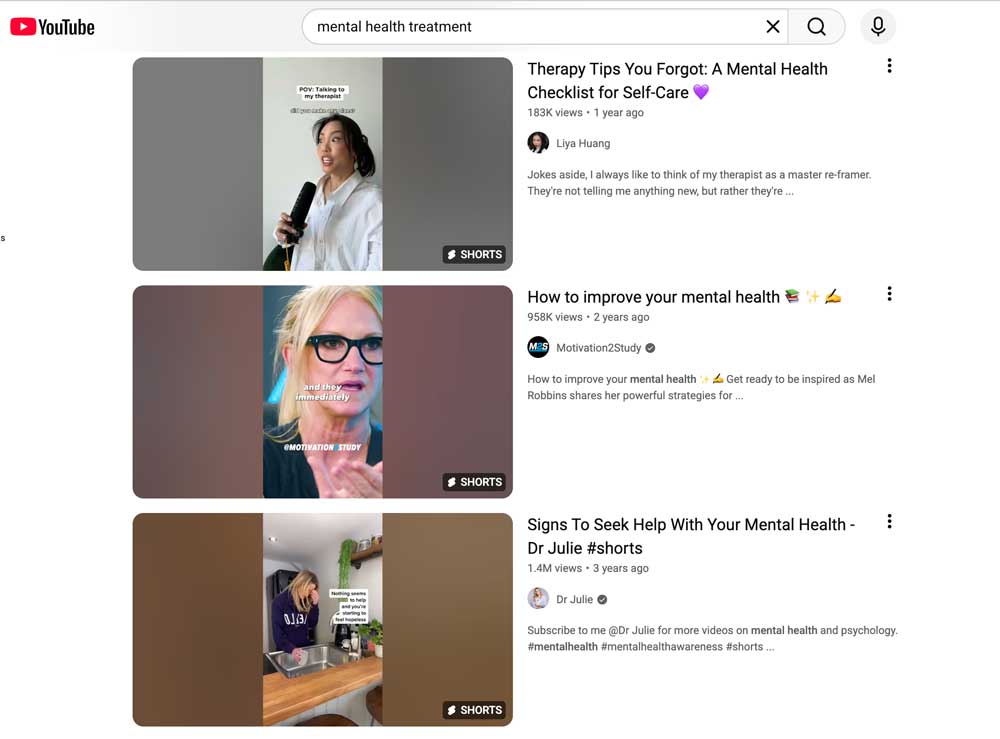
10 Shorts Ideas That Work For Addiction And Mental Health Providers
- How a confidential call works
- What happens after an assessment
- PHP vs IOP in 20 seconds
- What to bring for intake
- How insurance verification usually works
- Meet the team: what the clinical approach focuses on
- A calm look at the group room
- Family involvement options explained simply
- What a typical day can look like
- Three ways to support a loved one this week
These topics reduce confusion and set expectations, which helps both outcomes and conversion quality.
Three Simple Scripts Your Team Can Reuse
Script 1: Admissions Clarity (35–45 seconds)
“Here’s what happens when someone calls. It starts with a confidential conversation to understand what support is needed and what is going on right now. Then the team walks through options and answers questions. If insurance is part of the plan, verification can be started. If it looks like a fit, an assessment is scheduled. From there, next steps are laid out clearly so the process feels straightforward, not overwhelming.”
Script 2: Local Framing (20–30 seconds)
“This program supports adults in and around [City/County]. The focus is structured care, clear next steps, and a process that stays calm and practical. A lot of people feel nervous about reaching out, so the goal is to make it easier to understand what happens next and how to get support without pressure.”
Script 3: Levels Of Care (35–50 seconds)
“IOP is structured therapy a few days per week while living at home, so people can keep up with work, family, and daily life. PHP is more time-intensive during the week and can be a better fit when support needs are higher. The right level depends on safety, symptoms, and day-to-day stability, and the team can help clarify what makes sense during an assessment.”
What Success Looks Like In Month One
Do not overcomplicate metrics. Track a few signals consistently:
- GBP: calls, website clicks, direction requests.
- YouTube: views on Shorts, watch time, subscribers gained.
- Admissions: fewer “confused” calls, better-fit inquiries, more informed families.
Video is a trust channel. Early wins often show up as lead quality improvements before big reach numbers.
A Realistic Cadence For Busy Teams
A sustainable starting plan:
- 2 Shorts per week (batch record in 30 minutes).
- 1 GBP video per month (facility or “what to expect” clip).
- Quarterly refresh of your top 5 Shorts (re-record, keep messaging current).
Consistency beats intensity.
Trust Is The Strategy
When someone is nervous about reaching out, clarity matters. A simple, steady video presence helps people understand what happens next, what the environment feels like, and how to get support without pressure. That is the job. Everything else is extra.
Where This Fits Into ProDigital Healthcare’s Work
For addiction treatment and behavioral health brands, video is not a separate marketing project. It works best when it is built into the same system that drives local visibility, strengthens trust, and improves admissions-ready inquiries. The goal is simple: use short, privacy-safe videos to reduce uncertainty, reinforce credibility, and help the right people feel ready to call.
ProDigital Healthcare helps providers turn that into a repeatable plan that fits real-world constraints, including compliance, staff time, and multi-location consistency. That includes identifying the best video topics for each level of care, building a safe filming workflow, aligning videos with Google Business Profile and local search intent, and mapping content to the exact questions admissions teams hear every day.
Need a clear video plan that supports local rankings and better-fit inquiries? Reach out to ProDigital Healthcare for a consultation to review the current marketing strategy, identify quick wins, and build a simple weekly video rhythm that is realistic for the team and aligned with growth goals.