With nearly 50 million Americans aged 12 and older meeting the criteria for a substance use disorder each year (SAMHSA National Survey on Drug Use and Health), the demand for addiction treatment has never been greater. Yet with thousands of treatment facilities nationwide competing for those patients, simply having open beds and a good program is not enough.
Effective addiction treatment marketing is how you connect the people who need help with the facility that can provide it, at the exact moment they are ready to act. This guide breaks down the strategies, channels, and benchmarks that drive real admissions growth, not just website traffic.
Whether you run a single outpatient clinic or manage marketing for a multi-location residential program, the framework here applies. Let’s get into what actually works.
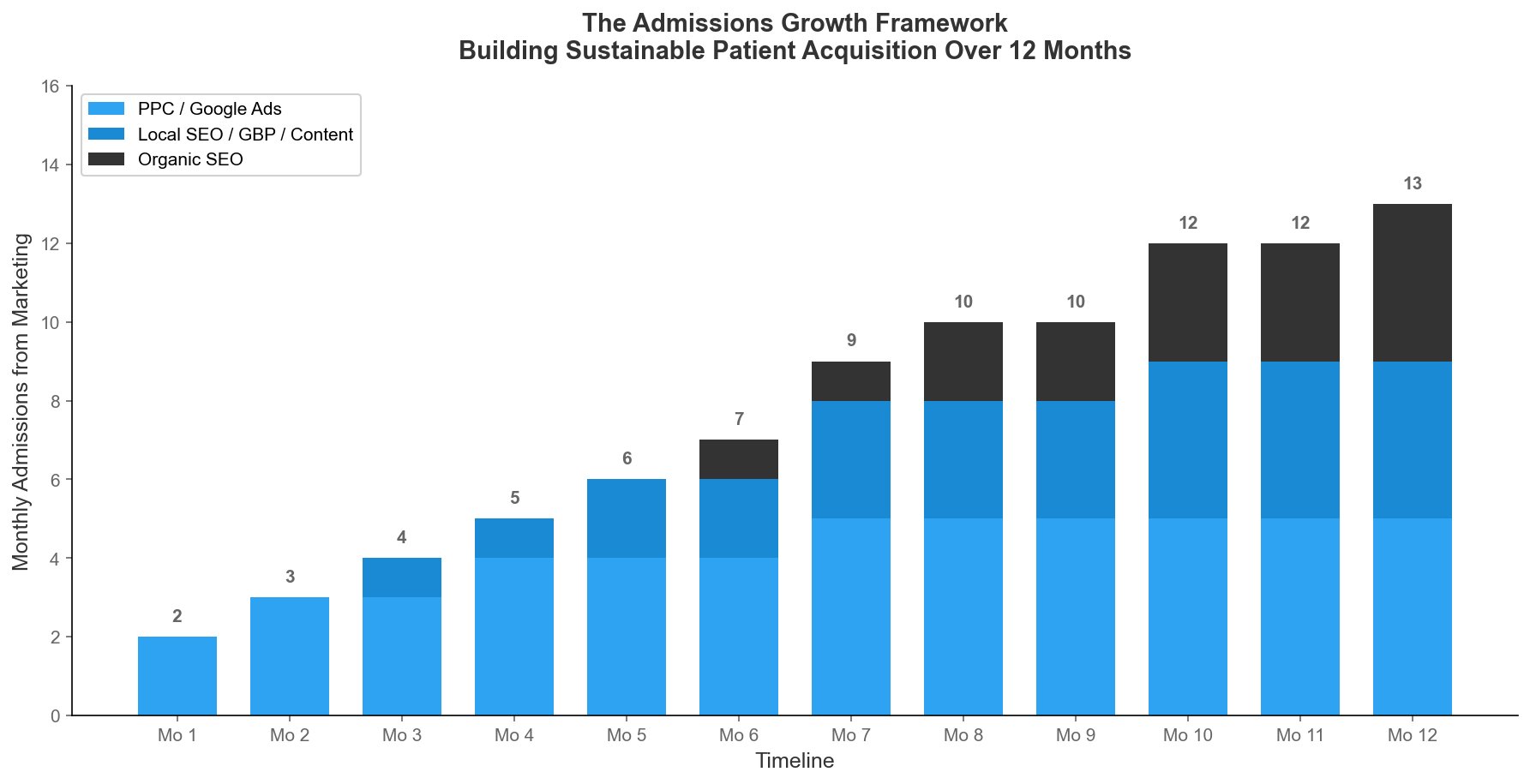
These figures represent estimated national averages and are for informational purposes only. Individual performance varies significantly by program type, location, competition, and budget. These are not guaranteed results.
Why Addiction Treatment Marketing Is Different
If you have tried applying general healthcare marketing playbooks to your treatment center, you have likely noticed the results fall short. There is a reason for that. Addiction treatment marketing operates under a unique set of conditions that change everything about how you attract, engage, and convert prospective patients.
Urgency-driven searches. Most people searching for addiction treatment are in crisis. A family member discovered drug paraphernalia, a spouse reached a breaking point, or someone woke up and decided today is the day. These are not casual researchers, they need answers immediately. Your marketing has to meet that urgency with clear next steps and fast response times.
Family members drive the decision. In many cases, the person searching is not the one who needs treatment. A parent, spouse, or sibling is doing the research, comparing facilities, and making the call. Your messaging needs to speak to their fears, questions, and decision criteria, not just the patient’s.
Insurance verification is a conversion gate. Before a family commits, they want to know one thing: “Will our insurance cover this?” If your website does not make insurance verification easy and immediate, you are losing admissions to competitors who do.
Referral networks and digital work together. Treatment center marketing is not purely digital. Relationships with therapists, interventionists, hospital discharge planners, and alumni all drive referrals. The most successful centers integrate their digital presence with their referral network, each channel reinforcing the other.
General healthcare marketing misses the mark. Standard healthcare marketing assumes a longer consideration cycle, an informed consumer comparing features, and a straightforward conversion path. None of that applies here. The decision window is compressed, emotions run high, and the stakes feel life-or-death, because sometimes they are.
Understanding the Patient Journey
Before you invest in any marketing channel, you need to understand how families and individuals actually find and choose a treatment center. The patient journey in behavioral health marketing looks nothing like a typical consumer funnel.
How People Search for Treatment
Search queries reveal intent. Someone typing “signs of opioid addiction” is early in awareness. Someone typing “drug rehab in Phoenix that accepts Blue Cross” is ready to act. Your marketing strategy needs content for both stages, but the high-intent, insurance-and-location-specific searches are where admissions happen.
Common high-converting search patterns include:
- Insurance-modified queries: “rehab that accepts Aetna,” “does Cigna cover inpatient rehab”
- Location-based queries: “drug rehab near me,” “alcohol treatment center in [city]”
- Program-specific queries: “dual diagnosis treatment center,” “medical detox program”
- Urgency signals: “emergency drug rehab,” “same day admission rehab”
The Decision-Making Timeline
Here is what makes treatment center marketing so different from other industries: the window from first search to admission is often just 24 to 72 hours. A family member starts searching on Tuesday evening, compares three to five facilities on Wednesday, calls two of them Thursday morning, and drives their loved one to intake Thursday afternoon.
That compressed timeline means your website must answer every major objection in a single visit. Your phone must be answered by a trained admissions team, not a voicemail. And your follow-up process cannot wait until “the next business day.”
Key Conversion Touchpoints
The touchpoints that most influence the admissions decision are:
- Phone calls: In addiction treatment, the phone call is king. Many facilities report that 70-80% of admissions originate from a phone call, not a form submission.
- Insurance verification: Online or phone-based verification that removes the financial uncertainty.
- Facility photos and virtual tours: Families want to see where their loved one will stay.
- Staff credentials and bios: Trust signals that demonstrate clinical expertise.
- Reviews and testimonials: Social proof from real families who have been through it.
Treatment center website conversion rates average 2-5% for form submissions, but phone call conversions often exceed that. If you are only tracking form fills, you are measuring a fraction of your actual performance.
The Admissions Growth Framework
Growing admissions is not about finding one magic channel. It is about building a system where multiple channels work together, each one compounding the effectiveness of the others.
Think of it as three layers:
- Immediate results (PPC, paid search): Start generating calls and admissions within days. Higher cost per acquisition, but predictable and scalable.
- Medium-term growth (Local SEO, GBP, content): Takes 3-6 months to gain traction. Lower cost per admission once established. Builds a durable competitive advantage.
- Long-term dominance (organic SEO, authority building): Takes 6-12+ months. Highest ROI channel once ranking. Difficult for competitors to replicate.
The centers that grow fastest run all three layers simultaneously. PPC funds the operation while SEO and content build the foundation for sustainable, lower-cost admissions over time.
SEO for Treatment Centers
Organic search is typically the highest-ROI channel for rehab marketing over a 12-month horizon. When someone types “drug rehab in Dallas” and your center appears in the top three results, you are getting a qualified, high-intent visitor at no per-click cost.
But SEO for addiction treatment is harder than SEO in most industries. Here is why and what to do about it.
Keyword Strategy
Your keyword strategy should target three categories:
- Insurance-modifier keywords: “rehab that accepts Aetna,” “Cigna drug rehab coverage,” “does UnitedHealthcare cover inpatient rehab.” These convert at some of the highest rates because they indicate a person ready to verify and enroll.
- Location-based keywords: “drug rehab in [city],” “alcohol treatment center [state],” “detox near [neighborhood].” These are your bread and butter for local patient acquisition.
- Program-specific keywords: “dual diagnosis treatment center,” “MAT program near me,” “adolescent drug rehab,” “PHP mental health program.” These attract patients seeking exactly what you offer.
Build dedicated landing pages for each keyword cluster. A page optimized for “drug rehab in Scottsdale” should not also try to rank for “alcohol detox in Phoenix.” Focused pages with specific, relevant content outperform generic ones.
E-E-A-T and YMYL
Google classifies addiction treatment content as “Your Money or Your Life” (YMYL), meaning it holds this content to a higher standard. You need strong Experience, Expertise, Authoritativeness, and Trustworthiness (E-E-A-T) signals:
- Author bios with clinical credentials on every article
- Citations to peer-reviewed research and government sources (SAMHSA, NIDA)
- Accurate, up-to-date medical information reviewed by licensed clinicians
- Clear “About Us” pages with leadership bios, accreditations, and licensing information
Technical SEO
On the technical side, treatment center websites should implement:
- Schema markup:
MedicalOrganization,LocalBusiness, andFAQPagestructured data help Google understand your content and display rich results. - Site speed: Pages should load in under 3 seconds. Slow sites lose impatient, crisis-driven visitors.
- Mobile optimization: The majority of addiction treatment searches happen on mobile devices. Your site must perform flawlessly on a phone screen.
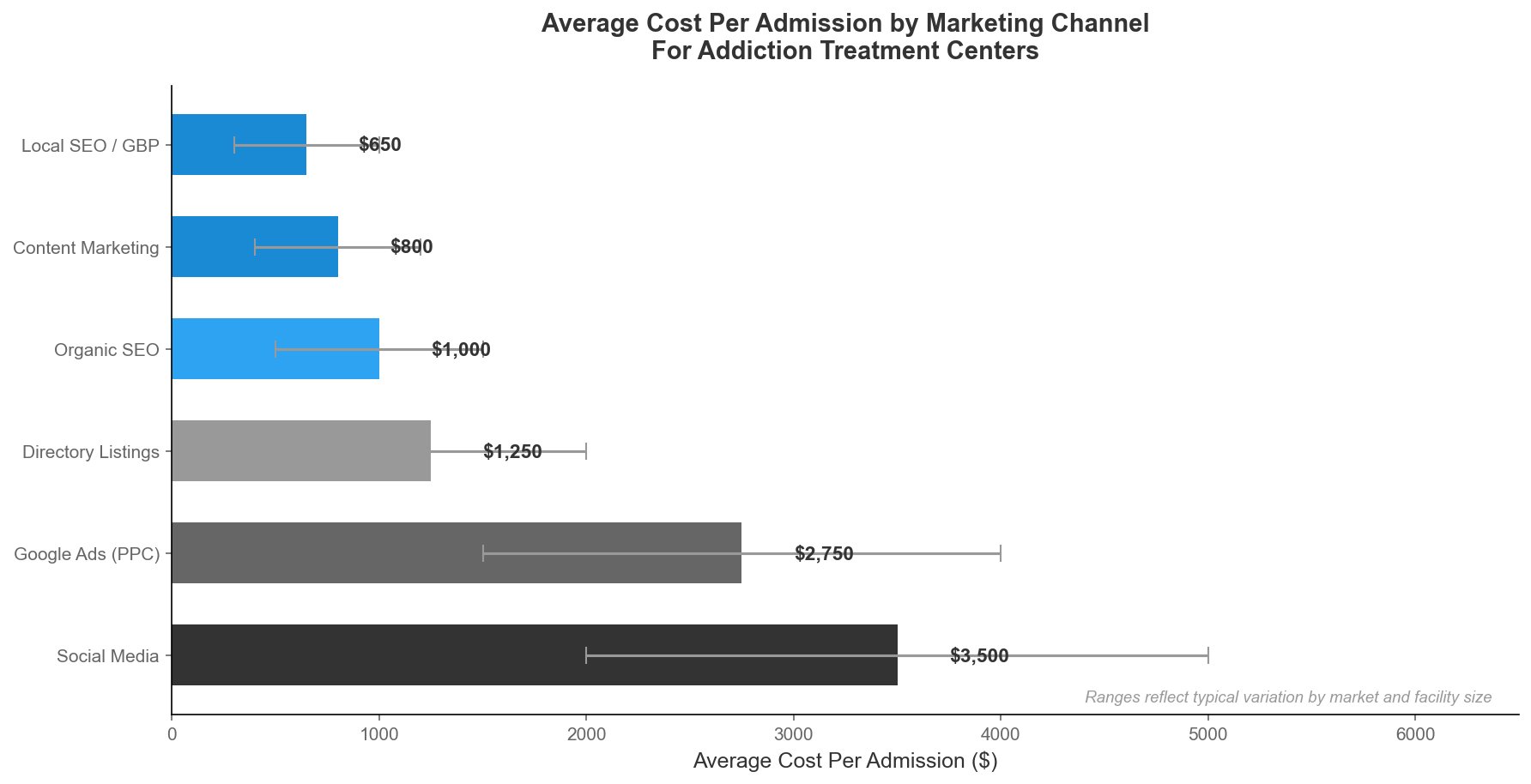
These figures represent estimated national averages and are for informational purposes only. Individual performance varies significantly by program type, location, competition, and budget. These are not guaranteed results.
PPC and Google Ads for Addiction Treatment
Pay-per-click advertising delivers the fastest path to new admissions. You can launch a campaign this week and start receiving calls from people seeking treatment. But addiction treatment PPC comes with unique challenges and significant costs.
CPC Benchmarks and Costs
Google Ads CPCs for addiction treatment keywords range from $30 to $100+ depending on your geography, target program type, and competition level. Major metro areas like Los Angeles, New York, and South Florida sit at the high end. Smaller markets can see CPCs in the $15-$40 range.
What matters more than CPC is your cost per admission. A $75 click that converts at 5% costs $1,500 per admission, which may be highly profitable for a residential program. A $30 click that converts at 1% costs $3,000 per admission. Optimize for admission cost, not click cost.
Campaign Structure
Effective treatment center PPC campaigns segment by:
- Program type: detox, residential, PHP, IOP, each with its own ad groups and landing pages
- Insurance type: campaigns targeting specific insurance carriers your facility accepts
- Geography: location-targeted campaigns for each metro area you serve
- Intent level: separate campaigns for high-intent terms (“rehab near me”) vs. informational terms (“signs of addiction”)
Landing Page Optimization
Your landing pages should include:
- A clear, prominent phone number (click-to-call on mobile)
- An insurance verification form above the fold
- Trust signals: accreditations, staff credentials, facility photos
- A short, empathetic headline that speaks to the visitor’s crisis
- A streamlined form, name, phone, insurance. Do not ask for more than you need.
Microsoft Ads
Do not overlook Microsoft Ads (formerly Bing Ads). The audience skews older, which aligns well with parents searching for treatment options for adult children. CPCs are typically 30-50% lower than Google, and competition is significantly less intense.
Content Marketing That Builds Authority
Content marketing for treatment centers serves two purposes: it attracts organic traffic through SEO, and it builds the topical authority that Google rewards with higher rankings across your entire site.
Blog Topics That Drive Traffic
Focus your content on topics that prospective patients and families actually search for:
- “What to expect during medical detox”
- “How to convince a loved one to go to rehab”
- “Does [insurance provider] cover drug rehab?”
- “Difference between inpatient and outpatient treatment”
- “Signs of [substance] addiction”
Write in accessible, empathetic language. Avoid clinical jargon unless you are defining it for the reader. These are people in pain looking for answers, not medical professionals.
Video Content
Video is increasingly important for treatment center marketing. Consider producing:
- Facility tours: Give families a virtual walk-through of your center. This builds trust and reduces the anxiety of the unknown.
- Staff introductions: Put faces and credentials to names. A 60-second video of your clinical director explaining your treatment philosophy builds more trust than a paragraph of text.
- Patient journey explainers: Walk through the admissions process, what the first week looks like, and what happens after discharge.
Downloadable Resources
Gated and ungated resources like “Insurance Verification Guides,” “What to Pack for Rehab” checklists, and “How to Talk to Your Loved One About Treatment” PDFs accomplish two things: they provide genuine value and they capture contact information for follow-up.
Building Topical Authority
Each piece of content you publish strengthens the authority of every other page on your site. A treatment center with 50 well-written articles covering detox, specific substances, insurance, family support, and aftercare sends a strong signal to Google: this site is a comprehensive resource on addiction treatment. That topical authority lifts your service pages in the rankings.
Local SEO and Google Business Profile
For treatment centers that serve a defined geographic area, local SEO may be your most valuable channel. When someone searches “drug rehab near me,” the Google Business Profile (GBP) results appear above organic results, and those listings drive significant call volume.
GBP Optimization
Your Google Business Profile should include:
- Accurate primary category: “Addiction treatment center” or “Drug and alcohol treatment center”
- Complete service descriptions: List every program you offer, detox, residential, PHP, IOP, MAT, dual diagnosis
- High-quality photos: Facility exterior, interior common areas, private rooms, outdoor spaces. Update these quarterly.
- Q&A section: Proactively add and answer common questions about insurance, admissions, and your programs
NAP Consistency
Your Name, Address, and Phone number must be identical across every directory listing, your website, and your GBP. Inconsistencies confuse Google and dilute your local ranking signals. Audit your listings quarterly.
Review Management
Reviews are a top local ranking factor and a critical trust signal for families comparing facilities. Build a systematic approach:
- Ask satisfied families for reviews at or after discharge (never during treatment)
- Respond to every review, positive and negative, professionally and promptly
- Never offer incentives for reviews
- Address negative reviews with empathy and a willingness to resolve concerns offline
Key Directories
Beyond Google, make sure your facility is listed and optimized on:
- SAMHSA’s National Helpline directory: A trusted federal resource
- Psychology Today: High domain authority and strong organic traffic
- Treatment center directories: Rehabs.com, AddictionCenter.com, and similar sites
- Healthcare-specific directories: Healthgrades, Vitals
Social Media for Behavioral Health
Social media is not typically a direct admissions driver for treatment centers, but it plays an important supporting role in building brand awareness, community trust, and referral relationships.
Platform Selection
Not every platform deserves your time. For behavioral health marketing, focus on:
- Facebook: Largest audience, strong local community groups, effective for family-focused content
- Instagram: Visual storytelling, facility highlights, recovery awareness content
- LinkedIn: B2B referral relationships with therapists, interventionists, and healthcare professionals
- YouTube: Long-form video content (facility tours, educational content) that also supports SEO
Content Pillars
Organize your social content around four pillars:
- Education: Addiction facts, treatment process explanations, myth-busting
- Community: Recovery awareness events, local partnerships, holiday support resources
- Staff spotlights: Introduce your team, share credentials and treatment philosophies
- Program highlights: Showcase your facilities, unique programs, and differentiators
Navigating Platform Restrictions
Meta (Facebook and Instagram) and other platforms restrict advertising related to substance abuse treatment. Content restrictions and ad policy limitations mean you cannot run traditional paid social campaigns the way other industries can. Organic content and community building become your primary social strategy. Work with the platform’s specific policies rather than against them.
Compliance Essentials for Treatment Center Marketing
Compliance is a practical requirement of operating in this space. Here is what you need to have in place.
HIPAA Considerations
- Website forms: Ensure all form submissions are encrypted and stored in HIPAA-compliant systems. Standard WordPress contact forms may not meet requirements.
- Tracking pixels and retargeting: Be cautious with Facebook Pixel, Google Analytics, and other tracking tools. Retargeting website visitors can risk exposing protected health information if not configured properly.
- Testimonials: Patient testimonials require explicit written authorization. Never use patient names, images, or identifying details without documented consent.
- Call tracking: Call recording and tracking must comply with both HIPAA and state-level consent laws.
LegitScript Certification
Since September 2017, Google has required LegitScript certification for any treatment center running Google Ads. This certification verifies your facility’s licensing, accreditations, and business practices. Without it, Google will not approve your ads. The certification process takes 4-8 weeks and requires annual renewal. Budget for this timeline before planning your PPC launch.
Meta also requires LegitScript certification for treatment-related advertising on Facebook and Instagram.
Google Ads Restrictions
Google restricts ad content for addiction treatment, including:
- No call-only ads (as of recent policy updates, verify current requirements)
- Ads must direct to the certified facility’s own website
- No lead generation or aggregator models
- Ad copy must accurately represent the advertised services
Measuring What Matters
The most important number in addiction treatment marketing is not clicks, impressions, or even leads. It is admissions. Every metric you track should connect back to the question: “How many patients did this channel bring through the door?”
Core Metrics
- Admissions by channel: Track which marketing channels (SEO, PPC, referral, direct) produce actual admissions, not just inquiries.
- Cost per admission by channel: Divide total channel spend by admissions generated. This is how you allocate budget effectively.
- Phone call volume and quality: Use call tracking with recording (HIPAA-compliant) to measure call volume and score call quality. A call that lasts 8+ minutes is a very different signal than a 30-second hang-up.
- Form submission-to-admission rate: What percentage of form fills convert to admissions? If the rate is low, the problem may be follow-up speed, not marketing.
Attribution Challenges
Patient journeys in addiction treatment rarely follow a clean, single-touch path. A family member might see a PPC ad on Tuesday, read a blog post on Wednesday, check your Google reviews on Thursday, and call on Friday. Which channel gets the credit?
Use multi-touch attribution where possible, but do not let perfect attribution be the enemy of directional data. At a minimum, ask every caller and intake form: “How did you hear about us?” and track the answers consistently.
When to Bring in a Specialized Agency
Many treatment centers start with in-house marketing or a general digital agency. That can work up to a point. But there are clear signs it is time to consider working with a drug rehab marketing agency that specializes in this space:
- Your admissions have plateaued despite increasing your marketing budget
- Your cost per admission is rising and you cannot identify why
- You are struggling with compliance: LegitScript, HIPAA, and Google Ads restrictions are consuming your team’s time
- You lack specialized benchmarks: You do not know if your numbers are good or bad relative to other treatment centers
- Your general agency does not understand the patient journey: They are optimizing for leads instead of admissions
What to Look For
When evaluating an addiction marketing agency, prioritize:
- Treatment field experience: They should know the difference between PHP and IOP, understand insurance verification workflows, and speak the language of admissions
- Understanding of the patient journey: Do they know that a 24-hour follow-up is too slow in this space?
- Proven results: Ask for case studies with actual admissions data, not just traffic growth
- Transparent reporting: You should see cost per admission by channel, not vanity metrics
Red Flags
Walk away from any agency that:
- Guarantees specific rankings (no one can guarantee Google’s results)
- Cannot explain their strategy specific to addiction treatment
- Focuses on traffic volume without tying it to admissions
- Does not ask about your admissions process, insurance panels, and capacity
Putting It All Together
Addiction treatment marketing is not about any single tactic. It is about building an integrated, multi-channel system that meets families at the moment of crisis and guides them toward the help they need.
The treatment centers that consistently grow admissions share a few things in common:
- They understand the patient journey and build their marketing around the compressed, urgency-driven decision timeline
- They invest across multiple channels: balancing the immediate results of PPC with the long-term compounding value of SEO and content
- They measure what matters: tracking admissions and cost per admission, not just clicks and impressions
- They work with people who understand this space: because the nuances of insurance verification, compliance requirements, and clinical credibility make generic marketing strategies insufficient
If your admissions numbers need to grow, the path forward is not a mystery. It is a system. Map the patient journey, build the right channels, measure real outcomes, and optimize continuously.
Ready to build a marketing strategy that drives measurable admissions growth? Schedule a free marketing assessment with our team to identify your biggest opportunities and get a custom roadmap for your facility.