

Table of Contents
AI referral traffic, the visits that reach your website from tools like ChatGPT, Perplexity and Gemini, has become one of the most talked-about numbers in treatment center marketing. Owners and admissions directors keep hearing that AI is the new front door for rehab and that programs which ignore it will be left behind. The real data tells a more useful story, and a more reassuring one.
AI search is changing how people research treatment. It is not yet changing where most of your calls come from. Understanding the difference keeps your budget pointed at what fills beds, while still positioning your program for where search is heading. If you are newer to how search fits into the bigger picture, our addiction treatment marketing guide covers the full system this sits inside.
Quick Summary
AI tools send a very small share of website traffic compared with Google, and that holds for treatment centers just as it does for other industries. That does not make AI search unimportant. It means AI works more like a reputation and shortlist channel than a traffic source, and the work that earns visibility in AI answers is largely the same work that wins on Google.
- Across large studies, AI assistants send less than 1% of the visits Google organic search sends
- Google still drives the overwhelming majority of conversions
- Google rarely shows AI Overviews on addiction searches, especially detox, withdrawal and near-me searches
- No special files or markup are needed; Google says optimizing for AI search is still SEO
How Much Traffic Does AI Actually Send?
Less than most people assume. One of the largest recent studies, by SEO consultant Marie Haynes, looked at 12 months of analytics across 100 websites and more than 145 million sessions. Sessions from ChatGPT equaled just 0.62% of the traffic Google organic search sent. Adding every other AI assistant only raised that figure to 0.73%.
For every 100 visits from Google, AI sends fewer than 1
Website sessions compared with Google organic search
Conversions told the same story. Among the 55 websites in her data that tracked conversions, visitors from ChatGPT converted at a much higher rate, 13.8% compared with 3.02% for Google organic visitors, yet Google organic still accounted for 96.5% of the conversions across the channels she compared. A separate benchmark of 95 websites found organic search sent 39 times more traffic than AI assistants, and AI delivered about 3 conversions for every 100 that came from organic search.
Healthcare is no different. A benchmark from Conductor found AI referrals made up 0.64% of all website traffic in the healthcare industry, below the average across the industries it measured, with ChatGPT responsible for most of it.
Even the higher conversion rate deserves a caveat. A peer-reviewed study of 973 online stores, published in the journal Marketing Science, found ChatGPT referrals made up less than 0.2% of traffic and converted below organic search. The researchers also noted that for more complex purchases, AI can add value by helping people structure information. Choosing a treatment program is about as complex as decisions get, which is part of why the influence question matters.
Across our broad set of clients, we have consistently seen the same pattern. For the treatment programs we work with, AI assistants send well under 1% of the visits Google organic search does. When AI visitors do arrive, they mostly land on homepages, program pages and location pages rather than blog articles. They are checking out a program, not reading about addiction.
There was also a period when AI referral traffic looked like it might overtake Google. Early growth was fast, and plenty of people in marketing drew a straight line upward. That line flattened. Haynes found the rapid growth in ChatGPT referrals stalled in the summer of 2025.
Why Low AI Traffic Does Not Mean Low Influence
If the story ended there, the answer would be simple: ignore AI and focus on Google. It does not end there. Use of AI search keeps climbing even as the clicks stay small. Google reports that AI Overviews reach more than 2.5 billion people a month and that AI Mode has passed 1 billion monthly users. OpenAI says ChatGPT has passed 900 million weekly users. Those people are asking questions and forming opinions. They are just not clicking through as often, because the answer is already on the screen. Ahrefs estimates that AI Overviews are associated with 58% fewer clicks to the top-ranking page. In other words, the biggest change to your traffic is happening inside Google, not in ChatGPT. Pew Research found that when Google showed an AI summary, people clicked a traditional result 8% of the time, compared with 15% when no summary appeared.
Health is one of the main reasons people turn to these tools. Pew found that 34% of U.S. adults have used an AI chatbot for at least one health-related reason, including learning about treatments and deciding whether to see a provider. KFF found that 16% of adults used AI for mental health information or advice in the past year, and more than half of them did not follow up with a professional.
Search marketer Mike King put it well in his response to the traffic studies: they grade a brand channel with a traffic ruler. Nobody judges a billboard by its click-through rate. When someone asks an AI tool which programs treat dual diagnosis near them, or what the difference is between PHP and IOP, the program named in the answer earns trust that never appears in a referral report. That influence may eventually show up as a branded search or a direct phone call, although connecting those actions to a specific AI recommendation remains difficult.
Early research backs this up. In a small study of people making major purchases with Google’s AI Mode, 64% of participants never clicked a single result, and most of their shortlists came straight from the AI’s answer. Brand recognition was one of the biggest reasons they trusted a recommendation. And when a brand is cited inside an AI Overview, Seer Interactive found it earns 35% more organic clicks and 91% more paid clicks than when it is not cited, though Seer is careful to say that does not prove cause and effect. For a treatment program running Google Ads, that last number is worth noticing.
We will be honest about the limits here, too. That influence is genuinely hard to measure. One analyst ran hundreds of statistical tests and could not establish a reliable link between AI visibility and later branded or direct traffic. Anyone who promises you a precise number of admits from AI visibility is guessing.
AI is changing how people research treatment long before it changes where your calls come from. We plan for both, and we measure what fills beds.
Dale Rowley, Co-Founder and CEO, ProDigital Healthcare
Where AI Answers Show Up in Addiction Searches, and Where They Do Not
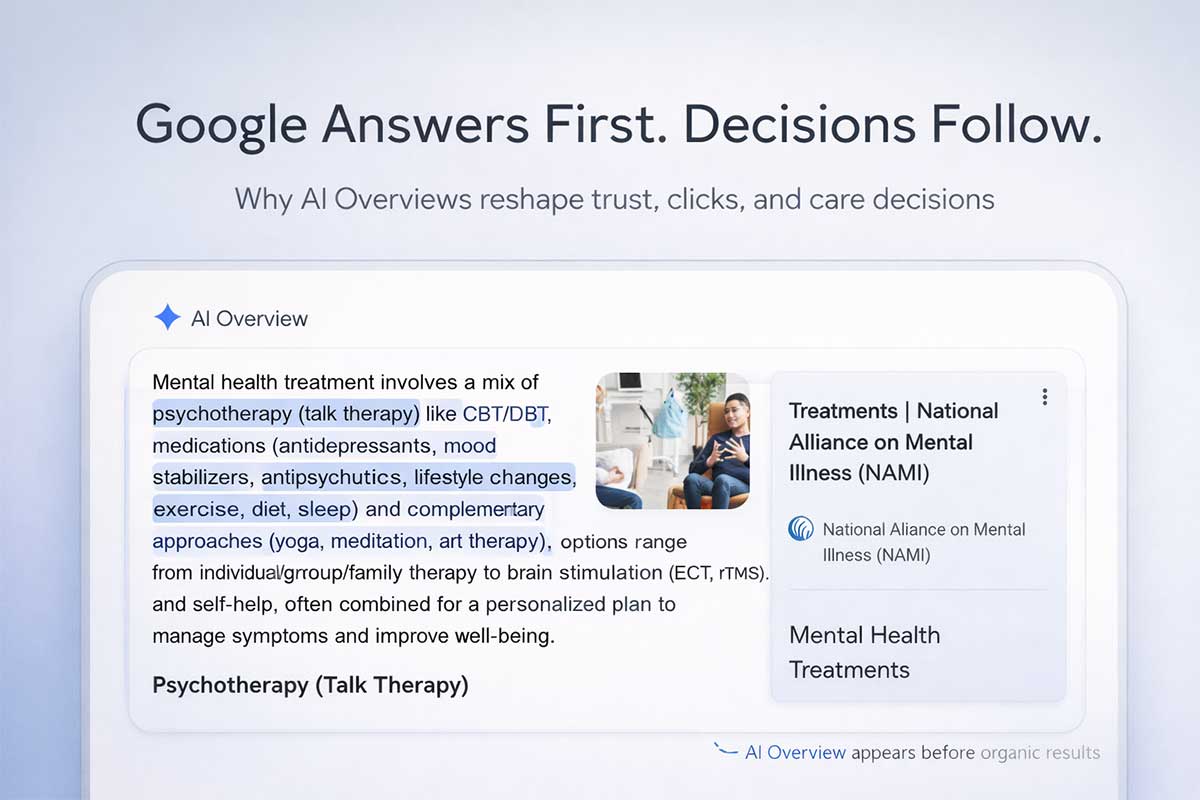
Here is something most treatment centers have not been told. For general health questions, Google shows an AI Overview at the top of the results nearly every time. For addiction searches, it often does not.
Our own monitoring of addiction and behavioral health search results shows how wide the gap is. Roughly 9 in 10 common general health questions showed an AI Overview. Fewer than 1 in 4 addiction-related searches did.
How often Google shows an AI Overview
Share of searches where an AI Overview appeared at the top of the results
Where the AI Overview disappears, Google usually shows something else. On detox, withdrawal and many signs-of-addiction searches, it often displays a box for the 988 Suicide and Crisis Lifeline with substance use support, and in our checks that box and an AI Overview never appeared on the same page. On “rehab near me” and city searches, the map and local listings take over. In both of those moments, someone is close to making a call, and Google is choosing to point them to a helpline or a nearby program instead of an AI-written summary. That is responsible, and it changes where your marketing effort matters.
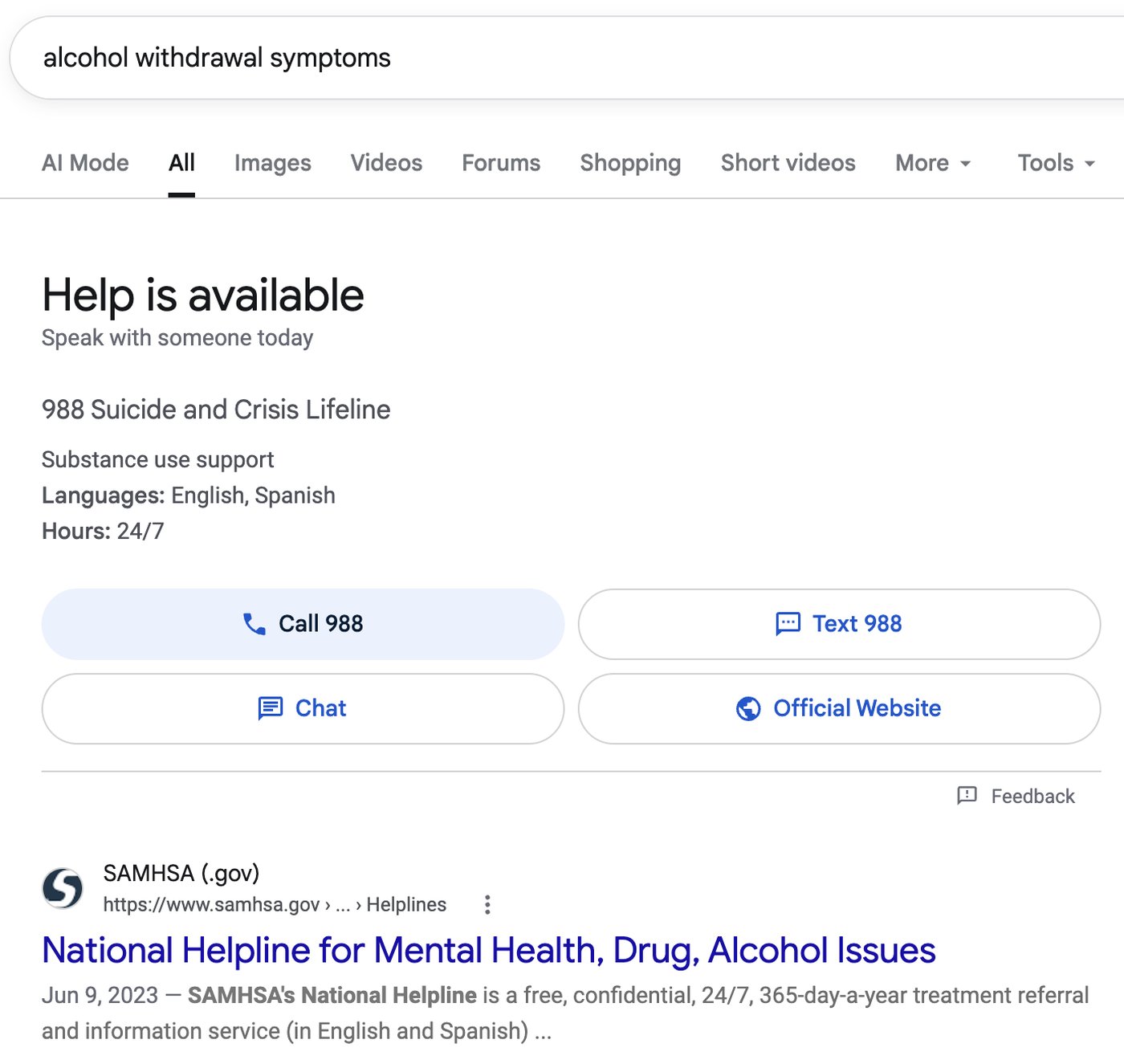
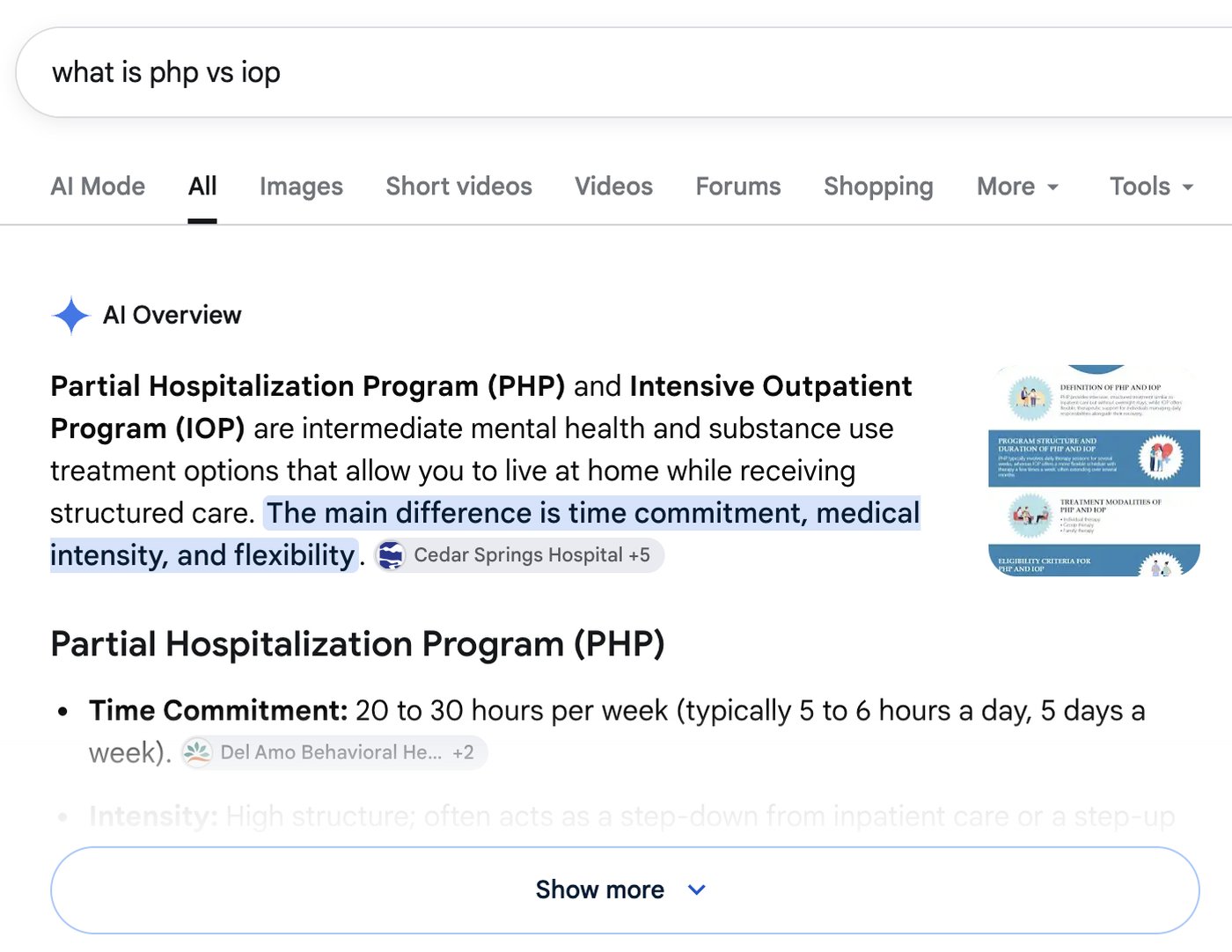
AI Overviews do appear on many educational searches, the questions people ask while they are learning about levels of care, treatment approaches and coverage. That is the research stage, where families and individuals build a shortlist. It is exactly where being part of the answer helps.
Where AI shows up as people search for treatment
Learning
Understanding the options
Questions about levels of care, treatment approaches and what coverage looks like.
AI answers are common here
Comparing
Building a shortlist
Weighing programs, reputations and fit, often inside AI tools like ChatGPT.
AI shapes who makes the list
Ready to call
Reaching out for help
Detox, withdrawal and near-me searches, where someone is close to picking up the phone.
Google shows the 988 Lifeline and the map, rarely AI
Myths About AI Search for Treatment Centers
“AI is replacing Google”
Not for treatment, and not soon. Google remains the dominant source of both traffic and conversions in every major dataset, including ours. A widely cited 2024 forecast predicted traditional search volume would fall 25% by 2026. Instead, Google’s CEO has since said that queries are at an all-time high. People are searching as much as ever. What has changed is how often they click. AI is being added to Google, not substituted for it.
“You need llms.txt files or special schema to show up in AI”
Google says otherwise. Its own guidance states that optimizing for generative AI search is optimizing for the search experience, and thus still SEO, that you do not need new machine-readable or AI text files, and that an llms.txt file will neither help nor harm your visibility in Google Search. It also says there are no additional requirements to appear in AI Overviews or AI Mode. Clean technical SEO and accurate structured data still matter. Tricks do not.
“AI visibility should be judged by AI traffic”
AI referral traffic remains small today, partly because these tools often answer questions without requiring a website visit. That makes referral traffic an incomplete measure of AI’s influence. The better questions are whether AI tools mention your program, describe it accurately, and recommend it for the services you actually offer.
“More blog content will get you into AI answers”
Volume is not the lever. AI visitors land mostly on core pages, and AI answers lean on sources that explain things clearly and credibly. A few strong, accurate program pages do more than dozens of thin articles.
GEO vs SEO: What Treatment Centers Actually Need
GEO, short for generative engine optimization, is the practice of trying to show up in AI-generated answers. SEO is the practice of showing up in search results. The industry has spent the past two years debating whether GEO is a new discipline that replaces SEO. For a treatment program, the honest answer is that GEO is mostly SEO done well, plus a few things worth adding.
| SEO | GEO | |
|---|---|---|
| Goal | Rank in search results and on Google Maps | Be included, and described accurately, in AI-generated answers |
| Where it shows up | Google search results and the local map | ChatGPT, Gemini, Perplexity and Google’s AI Overviews and AI Mode |
| Foundation | Clear program pages, a healthy website, consistent listings and real credibility | The same foundation |
| What it adds | Rankings, local visibility and pages built to convert | Monitoring what AI tools say about your program and correcting inaccuracies |
| How success is measured | Calls, VOBs, booked assessments and admits, with traffic and rankings as early signals | Mentions, recommendations and accuracy, measured against the same admissions outcomes |
AI visibility deserves dedicated monitoring and optimization. What it does not need is a separate program built on special files, markup tricks or content written for machines instead of people. If an agency pitches GEO as a replacement for SEO, ask what they would do differently from good SEO. The answer should be short.
What Actually Earns Visibility in AI and Google
You do not need to abandon your SEO strategy or build an entirely separate marketing program for AI search. You do need to understand where AI visibility differs and measure how these platforms represent your program. The same foundations drive both, which is why we build AI visibility into SEO for treatment centers rather than treating it as a bolt-on:
- Strong program pages that clearly explain your levels of care, who you treat, what treatment looks like and how admissions works.
- Accurate, consistent information everywhere, from your website to your Google Business Profile and directory listings, so AI tools and search engines describe your program correctly.
- Local presence for the urgent searches where Google shows the map instead of an AI answer.
- Third-party credibility, such as press coverage, accreditations, professional mentions and reviews, because AI answers draw heavily on what others say about you.
- Content people can trust, written with your clinical team and reviewed for accuracy. Video helps here as well, and our treatment center video ideas cover where it fits.
What Treatment Centers Should Measure
You do not need a new dashboard to stay on top of AI search, but you do need to look at the right things:
- AI referral traffic compared with organic search traffic, so you know how much AI is actually sending and whether it is growing
- Visibility in AI answers: whether your program is mentioned or recommended for the questions people in your market ask
- Accuracy: whether AI tools describe your levels of care, insurance and locations correctly
- Calls, VOBs, booked assessments and admits, with traffic and rankings as early signals rather than the finish line
Keep one caution in mind. An AI tool mentioning your program is a good sign, but it does not prove that a particular admission came from AI. Treat AI visibility as one input alongside the outcomes you can measure, not as a number to report on its own.
How We Approach AI Visibility for Treatment Programs
We take AI search seriously, which is exactly why we do not oversell it. We use proprietary AI search tracking to monitor how treatment programs appear across leading AI search platforms: which programs get named for the questions families and individuals ask in each market, whether our clients are cited or recommended, and whether the information about them is accurate. Combined with the website analytics and admissions data we review with our clients, that gives us a firsthand view of where AI is influencing treatment decisions and where traditional search is still doing the heavy lifting.
Accuracy is the part most programs overlook. An AI tool telling someone your program offers medical detox when it does not, listing an insurer you stopped working with, or naming an old location sends the wrong people your way and turns the right ones off. That is why AI visibility is part of the AI search optimization work we do for treatment programs, with dedicated monitoring and optimization built on the same foundation as their SEO, local search and content.
At the same time, we keep the focus where the admissions are today. For most programs, that means winning the searches people make when they are ready to call, and making sure every channel is measured against what fills beds.
Frequently Asked Questions About AI Referral Traffic
What is AI referral traffic?
It is website traffic that comes from AI tools such as ChatGPT, Perplexity, Gemini and Copilot. In analytics it usually appears as referral traffic from those tools, though some of it lands in direct traffic because certain apps do not pass along where the visit came from.
How much traffic does ChatGPT send to treatment centers?
Very little compared with Google. Large studies find AI assistants send less than 1% of the traffic that Google organic search does, and in our experience treatment centers follow the same pattern.
Does Google show AI Overviews for rehab and addiction searches?
Far less often than for other health topics. Many detox, withdrawal and near-me searches show the 988 Lifeline or local map results instead of an AI Overview. AI Overviews appear more often on educational searches about treatment types and coverage.
What is the difference between GEO and SEO?
SEO focuses on ranking in search results. GEO, or generative engine optimization, focuses on being included and described accurately in AI-generated answers. For treatment centers the two overlap heavily, and Google says optimizing for its AI features is still SEO. GEO mainly adds monitoring what AI tools say about your program and correcting inaccuracies.
Is AI search worth investing in for a rehab?
Yes, as part of a broader strategy rather than as a replacement for SEO. AI answers increasingly shape which programs people consider, so accuracy and visibility matter, but most calls and admissions still come through Google search and Google Maps.
How can I see what AI tools say about my program?
Ask the questions your future patients ask, in your market, across several AI tools, and note which programs are named and whether the details about yours are correct. Our free AI Visibility Snapshot does this for you.
See Where Your Program Stands
We have mapped where AI shows up in treatment searches and where it does not. Our free AI Visibility Snapshot applies that to your program. It shows:
- Which programs AI tools recommend for real treatment questions in your market
- Whether your program is cited, mentioned or recommended, or left out
- Anything AI tools are getting wrong about your services, insurance or locations
There is no sales call, just a clear picture of where you stand. Request your free AI Visibility Snapshot.
Sources
Marie Haynes: GEO Is a Distraction
iPullRank: AI Search Is Not a Distraction, It Is a Branding Channel
The SEO Works: AI Referral Traffic Benchmark
Growth Memo: Does AI Drive More Direct Traffic?
Google Search Central: Optimizing for Generative AI Features
Google Search Central: AI Features and Your Website
Alphabet: Investor Presentation
Alphabet: Q2 Earnings Remarks
OpenAI: Scaling AI for Everyone
Pew Research Center: Google Users Are Less Likely to Click on Links When an AI Summary Appears
Pew Research Center: Why Americans Use AI Chatbots for Health
KFF: Use of AI for Health Information and Advice
Frankfurt School: ChatGPT in Online Shopping (Kaiser and Schulze, Marketing Science)
Conductor: Health Care AEO and GEO Benchmarks
Search Engine Journal: How Consumers Navigate High-Stakes Purchases in AI Mode
Seer Interactive: AIO Impact on Google CTR
Ahrefs: AI Overviews Reduce Clicks
Search Engine Journal: Google Q1 Search Revenue