
Table of Contents
Quick Summary
Cost per admission varies far more between treatment programs than the national averages suggest. The figures that get passed around rarely explain where they came from, and they disagree with each other by more than 10x. What you will actually pay depends on your program: insurance network status, levels of care, what you treat, bed count, billing and market. Anyone quoting you one number before asking about those things is guessing.
- Published cost per admission claims range from about $1,500 to over $16,000, with almost no stated method.
- Real cost per click in well-managed rehab campaigns often runs half or less of keyword tool estimates.
- Network status, level of care, bed count and admissions follow-up move cost per admission more than bids do.
- Paid search calls that aren’t a fit can still become valuable referrals for business development partners.

Why National Cost per Admission Averages Fall Apart
Cost per admission is the first number most treatment center owners ask about, and it’s the number most often made up. You’ve probably heard $3,500 to $4,500 an admit quoted as the industry standard. So where does it come from? Mostly from marketers and consultants repeating it to each other for years. A lot of it traces back a decade or more, before Google restricted addiction treatment ads in 2017 and before LegitScript certification changed who’s even allowed to advertise. The market that number describes doesn’t exist anymore.
What’s published today isn’t much better. One widely shared statistics roundup puts cost per admission at $3,500 to $5,000. A sister page on the same site says $1,500 to $6,000. Neither explains how the figures were measured, and both trace back to a data aggregator, not real ad accounts. The only agency report we found that describes its sample, more than 50 mostly out-of-network centers, puts the average at over $16,000 per admission, with its best performers under $8,000. That’s roughly four times the number people repeat.
Some programs really do land near either end of that spread. A single national number just can’t describe all of them, and it tells you almost nothing about yours. That’s why our Google Ads management for treatment centers starts with your program’s economics, not an industry benchmark.
What Actually Sets Your Cost per Admission
Two programs in the same city can see completely different costs for the same admission. The difference comes down to:
- Insurance: in network, out of network, or PPO plans only
- Levels of care: detox only, residential only, or a full continuum through outpatient
- What you treat: substance use only, dual diagnosis, or mental health
- Size and capacity: a luxury residential program and a six-bed home can’t spend the same way
- Pricing and billing: what you charge, what each payer actually reimburses, and how many days of care get authorized
- Goals: filling a new program quickly, growing one service line, or holding census steady
What an admission is worth to your program decides what you can afford to pay for one. We don’t quote a number until we know these things, and neither should anyone else.
Program type changes the whole plan, not just the budget. That’s why we build addiction treatment marketing, behavioral and mental health marketing and marketing for sober living homes as separate strategies, each judged on its own path to a filled bed.
Keyword Tools Overstate What Rehab Clicks Really Cost
The other number that gets thrown around is cost per click. One 2026 roundup claims the average click for addiction treatment costs $94.50. Keyword research tools, including the estimates in Google’s own Keyword Planner, show similar figures. Those are projections of what it might cost to show up, not what well-managed campaigns actually pay.
Here’s how those estimates compare with the average cost per click across the treatment programs we manage over the past year, with branded searches excluded:
| Search theme | Keyword tool estimate (US) | What our clients actually paid |
|---|---|---|
| Detox | $107 (“detox near me”) | $24 to $36 |
| Alcohol rehab | $66 | $22 to $34 |
| Residential and inpatient | $44 to $63 | $17 to $36 |
| Drug rehab | Not shown by Google | $21 to $28 |
| Rehab and treatment centers | $46 (“rehab centers near me”) | $13 to $29 |
| Mental health treatment | $44 | $15 to $31 |
Our own accounts aren’t the only ones behind these numbers. We’ve audited and taken over ad accounts from other agencies, including some much larger ones, and gone through their past work line by line. So when we say what good looks like, we’re comparing it against a lot of what isn’t.
Google’s tools don’t even show data for many drug rehab searches, but those searches still run in live accounts, and we see what they cost. Keep in mind these are averages. In a poorly managed account, single clicks over $100 aren’t unusual.
Your market still matters. The same keyword tools put “detox near me” at $39 a click in Utah and $145 in New Jersey, a nearly 4x gap for the same search. Tight keyword lists, negative keywords, ad schedules and LegitScript certification all shape what you pay. Even so, a $94 national average click shouldn’t anchor your expectations.
Why Clicks Don’t Turn Directly Into Admissions
Even at about $22 a click, it takes hundreds of paid clicks to produce one admission. What happens after the click decides how many hundreds.
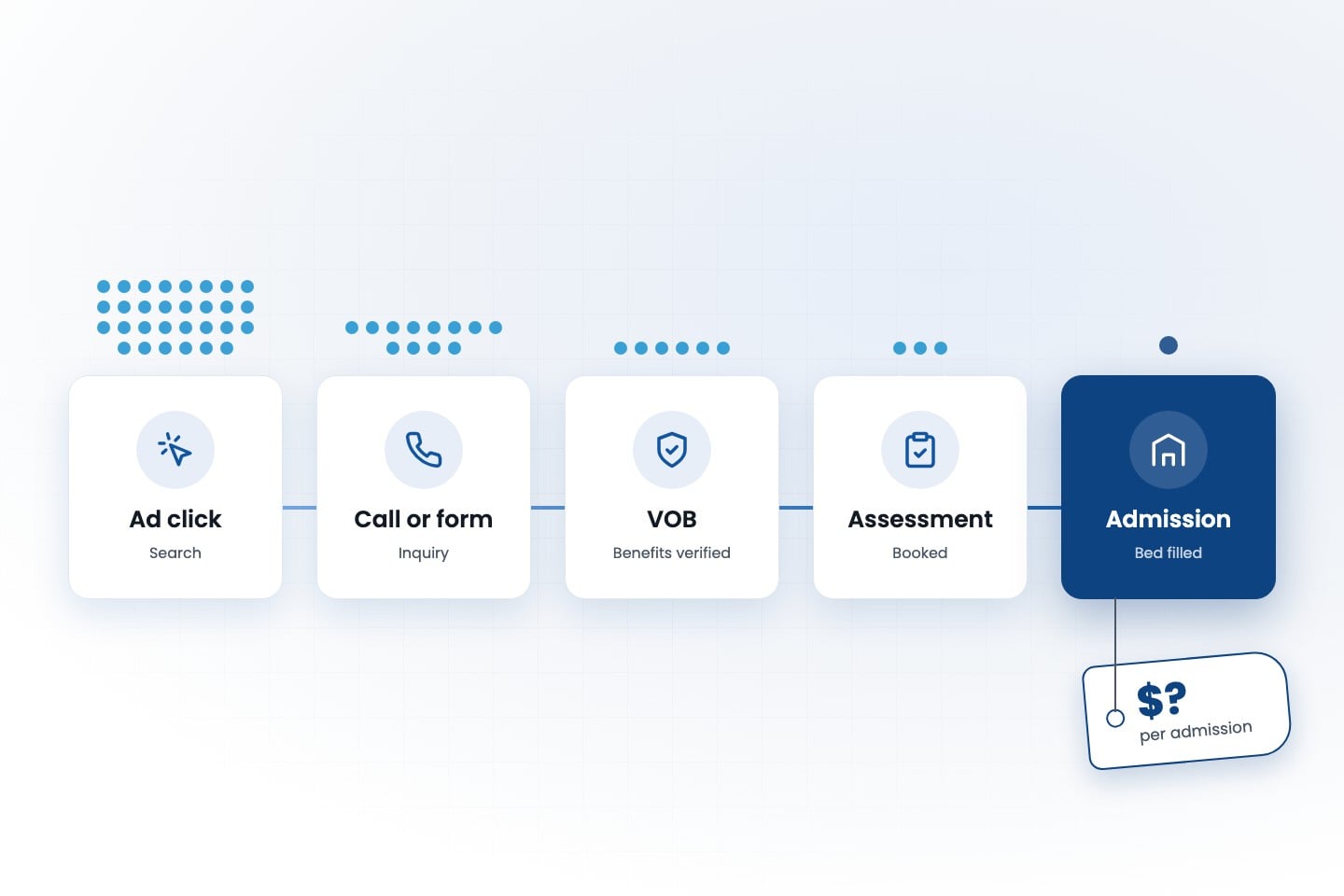
We track every program through the same path: calls and forms, first-time relevant callers, verifications of benefits, viable VOBs, booked assessments and admits. Ads control the first steps. Your admissions team controls the rest. How fast the phone gets answered, how a VOB gets followed up, whether a caller gets an assessment the same day: those move cost per admission as much as any bid change. We work with your admissions team on this part because it’s where a lot of marketing value gets lost.
We don’t take the call count at face value, either. We listen to every call that comes in for our clients and grade each lead. The real patient opportunities go back into Google Ads as custom conversions, so the campaign learns what a good caller actually looks like.
A lot of agencies count any caller who stays on the line 60 seconds as a lead. When we audit those accounts, many of those so-called leads turn out to be duplicate conversions that never should have been counted, spam calls, or people looking for Medicaid coverage the program doesn’t take. And when you tell Google those are leads, it goes out and finds you more of them.
Your website plays a part too. A slow landing page or a phone number buried below the fold loses callers you already paid for, which is why our treatment center website design is built around the moment someone decides to call.
Cost per admission also moves from month to month. Search volume rises and falls with the seasons. Insurance plays a part too: late in the year, many people have met their deductible or out-of-pocket maximum and look for care before it resets, while January brings new deductibles and a different kind of hesitation. That’s why we judge cost per admission over a quarterly data period, not a single month. One expensive month isn’t a trend, and neither is one cheap month.
Referrals: Value a Cost per Admission Figure Doesn’t Show
There’s one more reason cost per admission alone undersells paid search. Not every caller is a fit. Some need a level of care you don’t offer, an insurance plan you don’t take, or a program closer to home.
Handled well, those calls still have value. Your team can refer them to trusted partners, and those relationships tend to send people back to you. Many programs treat part of their ad budget this way: it fills beds directly and gives their business development team appropriate referrals to share with partners. None of that shows up in a Google Ads cost per admission, but it’s real value, and it belongs in how you judge the spend.
Paid search is also only one channel. Our addiction treatment marketing guide shows how ads, Google Business Profile rankings and SEO for treatment centers work together so no single channel has to carry your census.
Frequently Asked Questions About Cost per Admission
What is cost per admission?
Cost per admission is what you spend on marketing divided by the number of admissions it produces. For paid search, that is ad spend divided by admissions that came from your ads, which means you need call tracking and admissions data connected to know it.
What is the average cost per admission for a rehab?
There is no reliable national average. Published figures range from about $1,500 to over $16,000 and rarely explain how they were measured. Your cost depends on network status, levels of care, what you treat, bed count, billing and your market.
How much does a Google Ads click cost for addiction treatment?
Keyword tools often estimate $45 to $145 per click. In the well-managed treatment accounts we run, average non-branded clicks have run about $15 to $35, varying by search type and market.
Why is my cost per admission going up?
Common causes include rising click costs in your market, wasted spend on irrelevant searches, slower call answering or VOB follow-up, seasonality, and conversion tracking that counts the wrong things. Look at the whole path from click to admit before changing bids.
Get a Number You Can Actually Plan Around
Ask anyone quoting you cost per admission what it’s based on. A credible answer comes with questions about your insurance contracts, levels of care, bed count, billing, market, and how your admissions team handles calls today. It doesn’t come as a promise like “give us a $5,000 ad budget and we’ll get you 12 admissions.” Do the math: that’s about $400 an admission, fewer than 20 clicks each. Nobody running real treatment ad accounts can promise that.
That’s how every first conversation with us goes. If you want to work through the numbers for your program, built from what we see in real accounts, talk with our team and we’ll walk through it with you.
Sources
Google Ads Help: Use Keyword Planner
ProDigital Healthcare analysis of client Google Ads accounts, 12 months, branded searches excluded
Google Keyword Planner cost-per-click estimates by state, via DataForSEO